The Great Admin Transfer™
What Do Families Actually Have to Manage After Someone Dies?
We talk a lot about the transfer of wealth.
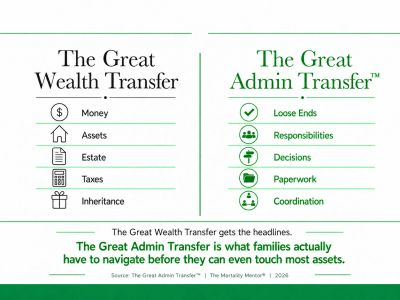
Far less attention is paid to the paperwork, decisions, coordination, and systems families are left to navigate when someone becomes incapacitated or dies.
The Great Admin Transfer™ is a new 2026 research report from The Mortality Mentor exploring what previous estate executors and the professionals who support them reveal about the hidden administrative work of incapacity and death.
Why are executors overwhelmed? Where does the process break down? And what could families, professionals, and institutions do differently?
This research is intended to spark that conversation.
What the research found
Families often expect tasks.
What they do not necessarily expect is the friction that comes with completing them.
Repeated paperwork. Multiple contacts. Unclear requirements. Rejected documents. Property and belongings to manage. Organizations that each have their own processes.
The research suggests that the administrative burden surrounding incapacity and death is broader than estate size, legal documentation, or individual preparedness.
It is shaped by a combination of:
- Loose ends — accounts, property, belongings, benefits, records, and responsibilities
- Coordination — family members, professionals, organizations, deadlines, and next steps
- Institutional processes — different rules, documentation requirements, handoffs, and points of access
A few findings from the report
70% of people with lived experience said the work was somewhat harder or much harder than expected.
Only 24% of those with prior experience as an estate executor considered themselves well prepared with their own affairs—suggesting that firsthand experience alone does not automatically translate into personal preparedness.
And the experience crossed estate sizes. 53% reported managing estates valued below $500,000, while 30% reported estates valued at $500,000 or more.
In fact, 24% were responsible for estates valued at under $100,000.
The work does not disappear simply because an estate is smaller. Participants described loose ends, scattered paperwork, property issues, unclear next steps, and repeated administrative hurdles that had little to do with wealth.
The Great Admin Transfer is shared, overloaded, and systemic.
The report introduces the SOS Framework for understanding the administrative reality of incapacity and loss.
Shared
Administrative complexity is only loosely correlated with financial complexity.
More wealth can add complexity. Less wealth does not remove it.
Overload
The hidden administrative work often exceeds expectations.
Families do not simply underestimate the number of tasks. They may also underestimate the time, complexity, coordination, and friction involved in completing them.
Systemic
The burden is shaped by the organizational processes people must navigate.
Having the right legal documents or being well organized can help—but preparedness cannot fully compensate for processes that are difficult, inconsistent, or unclear.
From SOS to shared responsibility
Taken together, the findings point to a broader conclusion:
Administrative burden is not created by one person, one profession, or one institution. And it will not be reduced by any one of them alone.
There are opportunities for:
- Individuals and families to prepare, organize, communicate, and test the handoff
- Professionals to anticipate administrative needs, coordinate where possible, and help people understand what comes next
- Organizations and public institutions to reduce unnecessary friction, clarify processes, and design for people navigating incapacity and loss
If the burden is shared, the response should be too.
Where do we go from here?
Better preparation matters.
But preparation alone will not solve the problem.
The Great Admin Transfer raises larger questions about what it really means to be prepared, where administrative burden comes from, who has the ability to reduce it, and how the work should be shared.
No single family, profession, organization, or technology platform can solve this alone.
Progress will require shared learning, better coordination, and a willingness to rethink the processes and systems people encounter during some of life’s hardest transitions.
This research is one step toward making that hidden work more visible—and opening the door for continued conversation, future research, organizational collaboration, and practical experimentation.
Download The Great Admin Transfer™
Read the full 2026 report for the research findings, participant perspectives, opportunities for individuals, professionals, organizations and public institutions, and questions worth exploring next.
DOWNLOAD THE REPORT (pdf)
Help continue the conversation
Did something in the report surprise you?
Are you seeing these challenges in your own family, profession, or organization?
We would love to hear what resonates, what questions the findings raise for you, and where you see opportunities to make the experience easier to navigate.
The Mortality Mentor®
Because grief and a to-do list don’t mix.
Media Kit
Press release, media notes and Robin Huffman bios.
Download the 2026 Media Kit (pdf)
DownloadHigh-Resolution Media Images

The Mortality Mentor® Logo (transparent png)

Robin Huffman Headshot (jpg)

Great Wealth Transfer vs. Great Admin Transfer (png)
53% Estates Below $500,000 (png)
24% Prior Executor Preparedness (png)

The House Became the Project (png)

Great Admin Transfer Journey Map (png)
Copyright © 2026 The Mortality Mentor - All Rights Reserved.
Disclaimer: All products and services are for educational and informational purposes only. Nothing on this page, the website, the services, or any of The Mortality Mentor’s content is a promise or guarantee of results. The Mortality Mentor LLC does not claim to be a licensed medical, financial, legal, or tax professional. We partner with these resources when needed (or can connect you with our network of professionals) to ensure that the tasks we complete for you are under their advice. Use caution and always consult your own advisors before acting on this or any information for after-loss services. You are responsible and accountable for your decisions, actions, and results thereof, and by your use of the services you agree not to attempt to hold The Mortality Mentor LLC liable for your decisions, actions, or results, at any time, under any circumstance. Any information or communication you provide to The Mortality Mentor LLC is not protected by an attorney-client privilege and are instead governed by our Privacy Policy. For additional information, please review our Terms & Conditions.
This website uses cookies.
We use cookies to analyze website traffic and optimize your website experience. By accepting our use of cookies, your data will be aggregated with all other user data.